
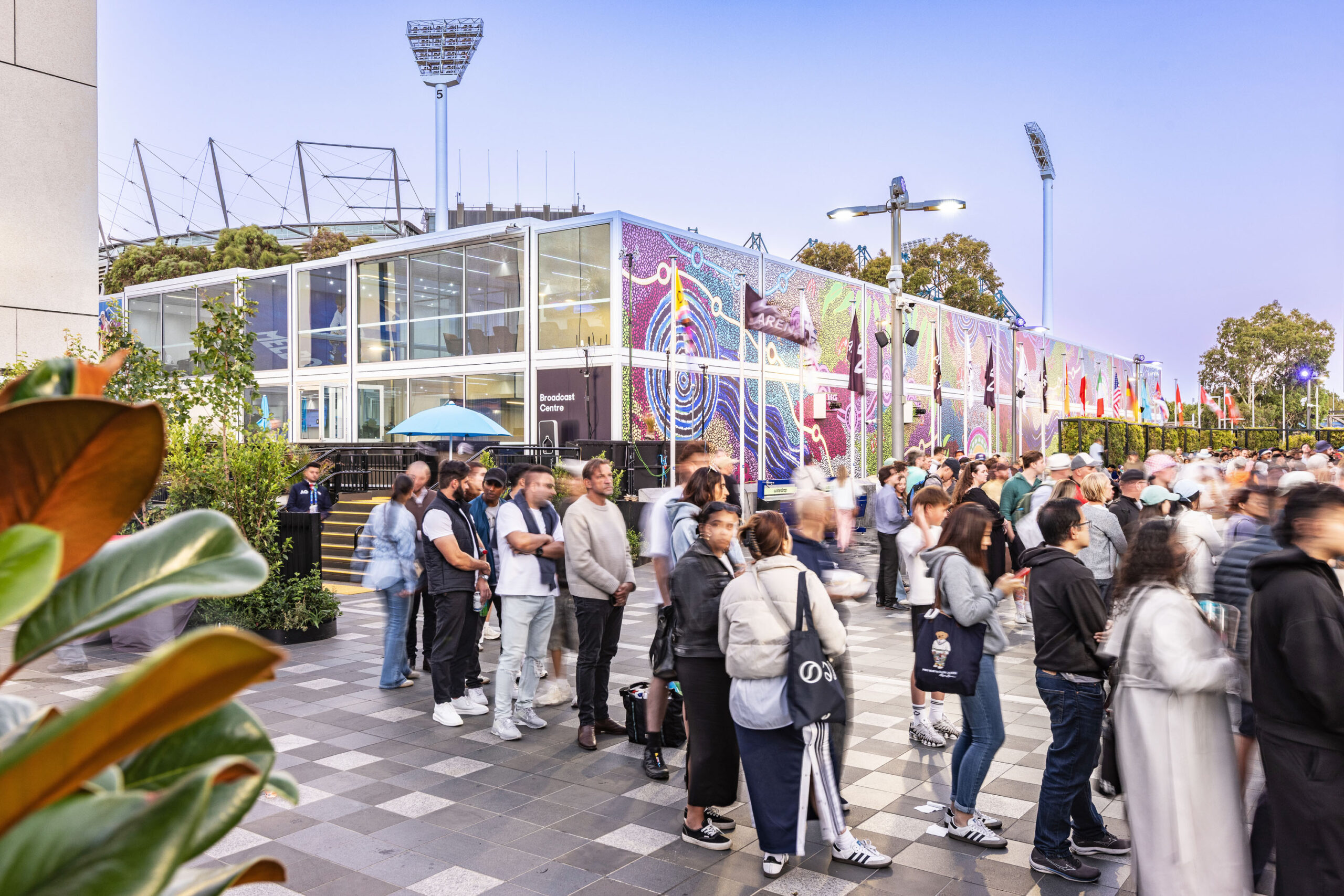
When the world’s biggest sporting events roll into town, there’s absolutely no time to waste. Event organisers often need high-quality spaces built quickly, designed around the event and, ideally, able to serve a purpose long after the event is over.
Traditional construction isn’t always suited to that kind of pressure. That’s where modular construction comes into play.
From Formula 1 hospitality suites to the Australian Open’s broadcast facility and pavilions at the Paris Olympics, SPACECUBE has seen this approach in action, creating flexible infrastructure without the lengthy timelines and material waste of traditional construction methods.
Why Major Events Are Turning to Temporary Modular Buildings
Major sporting events have to deliver impressive infrastructure within tight deadlines, often for facilities that may only be needed for a few weeks. Traditional construction can be difficult to justify in these situations, particularly when permanent structures may have limited use once an event is over.
So, what’s driving the shift to modular?
Tight Timelines
Major events demand rapid deployment. Modular structures can be built in days, fitting tight or accelerated event schedules.
Greater Cost Efficiency
Temporary infrastructure can provide the facilities an event needs without the long-term investment associated with permanent construction. Moreover, structures can be reconfigured for different applications, then adapted, relocated, or reused as requirements shift.
Less Waste
SPACECUBE structures are designed to be reconfigured and reused across different events.
Modules used at the Australian Open, for example, were redeployed just one month later for 11 custom structures at the F1 Australian Grand Prix.
Learn more about our approach to sustainability.
Modular Building Solutions for Stadium and Event Facilities
Designed for ease of transport and rapid assembly, SPACECUBE’s modular structures can be installed in days rather than months. The system also allows layouts to be adapted or buildings to be relocated as event requirements shift.
Key differences between modular and traditional construction include:
Factor
Modular Construction
Traditional Construction
Build Time
Days to weeks
Months
Material Use
Reusable and reconfigurable
Single-use
Post-Event Use
Relocate and reuse
Often demolished
Flexibility
Adaptable to different events
Fixed to the original build
This approach allows event organisers to deliver high-quality infrastructure faster while getting more value from each structure.
Proven Experience Across Major Sporting Events
SPACECUBE has delivered modular structures for major sporting events across Australia and internationally, from hospitality and broadcast facilities to retail spaces and brand activations.
Australian Open
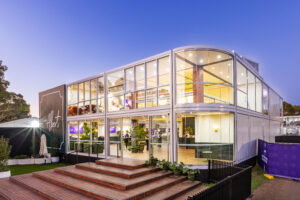
SPACECUBE supported the 2023 Australian Open by delivering a 3,000 sqm, three-storey broadcasting facility built with 94 cubes and 44 mezzanine modules.
Read more about this project here.
F1 Australian Grand Prix
At the Australian Grand Prix, SPACECUBE has delivered more than 3,400 sqm of event infrastructure. This includes multi-level hospitality facilities, broadcast spaces, retail and catering areas, and brand activations.
Read more about this project here.
Melbourne Cup Carnival
SPACECUBE has delivered structures across the Melbourne Cup Carnival, including hospitality and brand activation spaces within the Birdcage enclosure.
Read more about this project here.
FIFA Women’s World Cup
For the 2023 FIFA Women’s World Cup, SPACECUBE delivered custom modular retail activations for Rebel Sport in Adelaide and Brisbane. A second modular temporary store was then installed in Brisbane.
Read more about this project here.
International Sporting Events
Our experience extends beyond Australia, with modular structures delivered for events including:
- Sky Sports – Goodwood Festival of Speed
- Formula 1
- Paris Olympics
- Royal Ascot
- Premier League
- US college football
Modular Building Systems for Sporting Events
SPACECUBE’s modular system is designed to help sporting venues and event organisers create adaptable infrastructure with greater speed and control.
Designed for Flat-Pack Transport
SPACECUBE components are manufactured flat-packed. This helps to simplify transportation and on-site logistics, making it easier to move building components between locations and supporting faster installation when event deadlines are tight.
Built for Flexible Configurations
The SPACECUBE build system uses a structural design without load-bearing internal walls, giving event organisers greater freedom when planning their spaces. Buildings can be configured, extended, and even reconfigured to suit different operational requirements.
Plug-and-Play Components
Interchangeable wall systems, facade options, and accessories make it possible to create bespoke buildings using standardised components. This approach reduces design and construction lead times while helping minimise material waste.
Services Integrated into the Build
Our systems incorporate stormwater drainage, subfloors, ceiling systems and low-voltage lighting as part of the build. By integrating these services during manufacture, on-site installation is faster, simpler and less reliant on multiple external trades.
Get a Quote for Your Next Modular Structure
From grandstands and hospitality spaces to temporary facilities and event infrastructure, SPACECUBE makes it easier to deliver adaptable spaces around the demands of major sporting events.
Get in touch today with our team today to discuss your next sporting event project.
FAQs
Can modular building systems handle multi-level structures?
Yes, modular structures can absolutely handle multi-level structures. Our modular steel buildings have been deployed as two- and three-storey facilities at major events, including five multi-level hospitality suites at the F1 Australian Grand Prix and a three-storey broadcasting centre at the Australian Open.
What makes modular structures more sustainable than traditional builds?
Modular structures are more sustainable than traditional builds because they are designed for reuse, not demolition. Our modular systems cut material waste by up to 90%, with modules being repurposed and deployed across multiple events.
Unlike traditional construction, which generates significant waste and leaves behind permanent structures, flat-pack modular buildings can be relocated across multiple events and sites.
Are prefabricated modular buildings reusable across different events?
Yes, our modules travel between venues worldwide, reconfigured to suit each event’s layout. Rather than demolishing temporary construction after each event, we relocate each module to new sites, dramatically reducing waste.